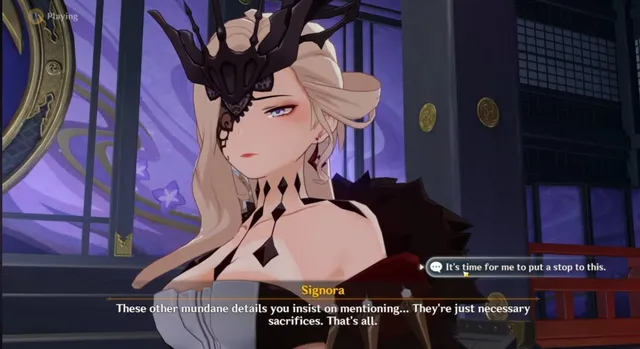
🎭 “Duel Before the Throne”: Did Signora Have a Choice? A Lore-Deep Breakdown of Genshin’s Most Morally Fraught Confrontation
SEO Title:
Did Signora Have to Fight the Traveler? The Truth Behind Inazuma’s “Duel Before the Throne” and Fatui Accountability
🔍 Summary
One of Genshin Impact’s most emotionally charged and ethically ambiguous moments—Signora’s fatal duel with the Traveler in Inazuma—has reignited passionate debate across the fandom. At the heart of this discourse lies a deceptively simple but lore-critical question: Was Signora legally, culturally, and politically obligated to accept the Traveler’s invocation of the “Duel Before the Throne,” or did she freely choose death out of pride? Drawing on canonical dialogue, Edo-era-inspired worldbuilding, and official HoYoverse narrative design principles, this guide cuts through fan speculation to deliver a definitive, evidence-based analysis. Spoiler-free for new players—but rich with insight for veterans dissecting the Fatui’s moral complexity and the Traveler’s evolving agency.
⚖️ Three Key Points
1. The “Duel Before the Throne” Was Not a Voluntary Challenge—It Was a Binding Ritual Enforced by the Shogun’s Decree
The Duel Before the Throne isn’t a casual sparring agreement—it’s a formalized, sovereign-sanctioned rite rooted in Inazuma’s Vision Hunt Decree legal framework. As confirmed in cutscenes and voice lines (e.g., Yae Miko’s narration and Raiden Shogun’s decree logs), any foreign entity invoking the Duel before the Tenryou Commission and the Shogun’s presence triggers an automatic, non-negotiable adjudication process. Signora didn’t “accept a challenge”—she was summoned to answer before the sovereign. Refusal would constitute treasonous defiance of the Shogun’s authority—not just bad manners, but an act that could have triggered immediate arrest, Vision confiscation, or even execution without trial. Her “yes” wasn’t consent; it was procedural compliance under duress.
2. Signora’s “Superiority Complex” Didn’t Override Protocol—It Masked Her Strategic Calculus
Yes, Signora exuded arrogance—but her decision to engage wasn’t ego-driven recklessness. Dialogue from Chapter II, Act III reveals she assessed the Traveler as a destabilizing variable threatening both the Fatui’s Inazuma operation and the Shogun’s stability. By accepting the Duel, she aimed to:
- Neutralize the Traveler publicly (preserving Fatui credibility),
- Avoid escalating tensions into open war with the Shogunate, and
- Maintain plausible deniability for the Tsaritsa’s involvement.
Her confidence stemmed from tactical certainty—not ignorance of consequences. She knew defeat meant death, yet judged the political cost of refusal higher. This reframes her final moments not as hubris, but as a cold, tragic calculus—making her one of Genshin’s most tragically layered antagonists.
3. The Traveler’s Moral Ambiguity Is Intentional—and Central to Genshin’s Narrative Evolution
HoYoverse deliberately avoids painting the Traveler as purely heroic in this arc. Their invocation of the Duel—knowing its stakes—was an act of immense moral weight, not innocence. As Yae Miko subtly implies (“You wield power like a blade… but who holds the hilt?”), the Traveler operated within Inazuman law while weaponizing its lethality. This moment marks a turning point: the first time the protagonist knowingly risks irreversible consequence for ideological victory. It foreshadows later arcs (Sumeru, Fontaine) where “righteous action” demands uncomfortable trade-offs—proving Genshin’s storytelling maturity lies precisely in refusing easy absolution.
💡 Final Thought: Signora didn’t choose to die—she chose how to die. And in that choice, Genshin Impact delivers one of gaming’s most haunting explorations of duty, dignity, and the quiet tragedy of being on the wrong side of history—wielding ice, not malice.
🔍 Want deeper lore? Check our companion piece: “The Fatui Harbingers’ Code: Honor, Obedience, and the Unspoken Rules of the Tsaritsa’s Court.”
Source: Compiled from Reddit r/Genshin_Impact discussion.