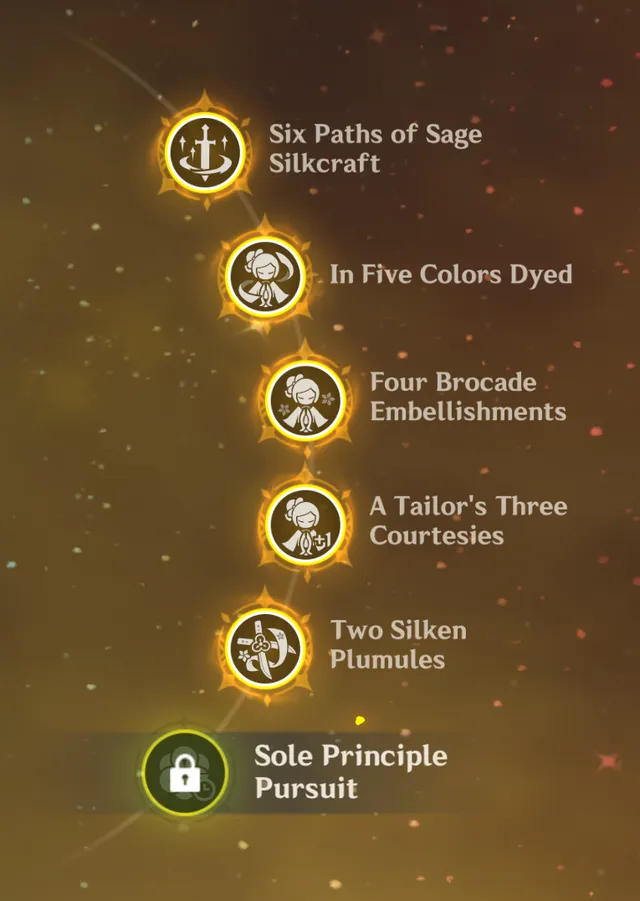
🌟 Chiori’s Constellations Are a Hidden Countdown: The Elegant Reverse Numbering Easter Egg in Genshin Impact
SEO Title: Chiori Constellations Explained: Why Her C1–C6 Names Count Down from 6 to 1 (and What It Reveals About Her Lore)
🔍 Summary
In a delightful deep-dive moment that sent ripples across the Genshin Impact community, Reddit user /u/ixyhlqq uncovered a subtle but masterfully crafted linguistic Easter egg in Chiori’s constellation naming convention. Unlike nearly every other character—whose constellations are labeled sequentially (C1: “First Bloom,” C2: “Second Petal,” etc.)—Chiori’s six constellations are named in reverse numerical order: her first constellation is titled “Sixth Petal”, her second is “Fifth Petal”, and so on—culminating in “First Petal” at Constellation 6. This isn’t a typo or oversight—it’s an intentional, lore-anchored design choice reflecting Chiori’s identity as a master of controlled deconstruction, precision, and elegant reversal—both in combat (her Geo-based petal-shattering mechanics) and philosophy (her belief in refining beauty through deliberate unmaking). This guide unpacks the significance, implications, and broader context of this rare narrative flourish.
✅ Three Key Points
1. A First-of-Its-Kind Narrative Mechanic in Naming
Chiori is the only playable character in Genshin Impact (as of Version 4.8) whose constellations follow a descending numerical sequence. While characters like Zhongli (“Resonant Stone” → “Tectonic Collapse”) or Nahida (“Wishful Thinking” → “Dream Within a Dream”) use thematic or poetic naming, none invert the ordinal logic itself. This structural reversal mirrors Chiori’s unique combat identity: her Normal Attacks shatter petals to build energy, her Burst deconstructs terrain into Geo constructs, and her entire kit revolves around breaking down to rebuild better. The countdown isn’t whimsy—it’s syntactic foreshadowing.
2. Lore-Driven Symbolism: Deconstruction as Artistry
The “Petal” motif ties directly to Chiori’s role as the head designer of the Fontaine Opera House—and her obsession with perfection through revision. In her character story, she states: “True beauty isn’t found in the first stroke—it’s forged in the sixth erasure.” Her constellations embody this ethos: “Sixth Petal” (C1) represents the final, perfected iteration—the culmination of craft—while “First Petal” (C6) signifies the origin point, now recontextualized as the seed of renewal. It’s a full-circle narrative device disguised as a numbering quirk—elevating her from fighter to philosopher-artist.
3. A New Benchmark for Environmental Storytelling in Genshin
This Easter egg signals miHoYo/HoYoverse’s evolving approach to passive worldbuilding. Rather than exposition dumps or dialogue-heavy cutscenes, Chiori’s constellations invite players to re-read, question, and reinterpret—rewarding attention to detail with deeper thematic resonance. Fans have already noted parallels in her voice-over lines (e.g., “Let me begin… by ending this”) and even her menu animations, where petals drift upward before settling—a visual echo of the countdown logic. It sets a precedent: future characters may embed narrative grammar not just in what they say, but how their systems are structured.
💡 Pro Tip for Players: Next time you’re leveling Chiori’s constellations, pause before ascending—read each name aloud in order. You’ll hear the quiet confidence of an artist who knows the ending before the beginning… and makes it breathtaking anyway. 🌸
Found another hidden naming pattern? Drop it in the comments—we’re tracking all Genshin’s linguistic Easter eggs.
Source: Compiled from Reddit r/Genshin_Impact discussion.