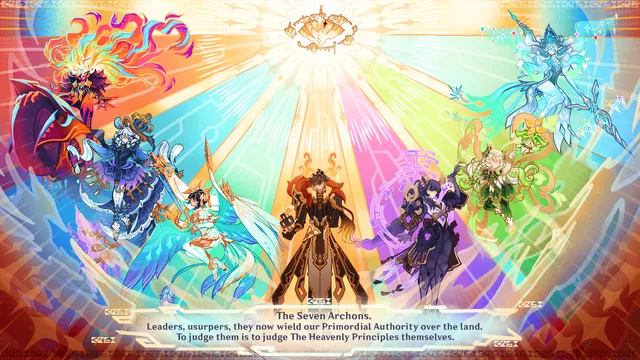
🌍 The Archons Decoded: A Complete Guide to Teyvat’s Divine Rulers (Genshin Impact Lore Deep Dive)
SEO Title:
Archons Explained: Who Are the Divine Rulers of Teyvat? — Genshin Impact Lore Guide, Powers, History & Hidden Truths
🔍 Summary
In Genshin Impact, the Archons are not just powerful NPCs—they’re the mythic, godlike sovereigns who shaped the seven nations of Teyvat. Each governs an element and a region, embodying both divine authority and profound philosophical themes: freedom, justice, wisdom, eternity, prosperity, harmony, and transcendence. This guide synthesizes canonical lore (from in-game quests, primordial texts like The Book of the Dead, and official HoYoverse materials) with community-driven insights from Reddit’s deep-dive discussions—most notably the viral visual primer by u/ImaginationHour1293. We clarify misconceptions, trace each Archon’s evolution (including their mortal vessels and “death” or succession), and reveal how their legacies actively drive the game’s overarching narrative—from the cataclysm to the Sustainer of Heavenly Principles.
✨ 3 Key Points Every Traveler Should Know
1. Archons Are Not Just “Gods”—They’re Contracts, Concepts, and Catalysts
The title “Archon” is less about omnipotence and more about covenant: each Archon embodies a fundamental principle tied to their nation’s identity and elemental resonance (e.g., Barbatos = Anemo + Freedom; Zhongli = Geo + Contract). Crucially, Archons are mortal vessels chosen—or forged—to host the divine “gnosis,” a crystallized will of Celestia. When an Archon dies (or abdicates), their gnosis may be reclaimed, transferred, or shattered—triggering seismic shifts in regional stability and elemental resonance. This explains why Liyue’s transition from Zhongli to the Qixing was peaceful (a negotiated contract), while Fontaine’s recent “divine trial” centered on proving who truly holds the right to rule—not just power.
2. The “Dead” Archons Are Alive in Spirit—and Still Pulling Strings
Contrary to early fan theories, no Archon has been permanently erased. Nahida (Dendro Archon) was imprisoned—but her consciousness persisted in the Realm of Dreams. Venti (Anemo Archon) faked his death to evade Celestia’s scrutiny. Even Eula’s ancestor, the “Fallen Archon” of Snezhnaya (unconfirmed but heavily implied), may represent a suppressed lineage—not extinction. Reddit analysis highlights recurring motifs: fragmented memories, dream echoes, and “echoes of the past” quests all reinforce that Archonic consciousness transcends physical form. Their influence lingers in ley lines, national ethos, and even NPC dialogue—making them active, if veiled, players in Teyvat’s present.
3. Celestia’s Control Is the Real Antagonist—Not the Archons Themselves
The biggest lore revelation (amplified by the Reddit thread’s visual timeline) is that all Archons operate under Celestia’s oversight—and many resist it. The “Divine Judgment” system, the gnosis confiscation protocol, and the Sustainer’s rigid enforcement of “heavenly principles” position Celestia as the true ideological antagonist. Characters like Zhongli, Nahida, and even the late Raiden Shogun evolved against this dogma—prioritizing mortal agency over divine decree. Understanding this hierarchy reframes every major quest: the Archons aren’t rulers of Teyvat—they’re guardians for Teyvat against celestial bureaucracy. That’s why the Traveler’s journey isn’t about replacing Archons—it’s about dismantling the system that binds them.
🔍 Did this guide unlock new layers of Teyvat’s lore? Drop your theories in the comments—and don’t forget to check out u/ImaginationHour1293’s original visual archive on r/Genshin_Impact for annotated maps and gnosis chronology!
Source: Compiled from Reddit r/Genshin_Impact discussion.